2-Day Nara Itinerary: World Heritage & National Treasure Trip
Nara, Japan’s first permanent capital, established in 710 AD, is a captivating city steeped in history and tradition. Famous for its friendly wild deer roaming freely in Nara Park, it offers visitors a unique blend of cultural heritage and natural beauty. Home to Todaiji Temple that houses a colossal bronze Buddha statue, and numerous other ancient temples and shrines, Nara provides a serene escape and a fascinating glimpse into Japan’s past.
Nara is conveniently located less than an hour away from both Kyoto and Osaka, making it an easily accessible destination for a day trip or a longer stay. Beyond the beloved deer park, visitors can explore the charming Naramachi district, with its well-preserved traditional merchant houses. Food enthusiasts should try local specialties like kakinoha-zushi (persimmon leaf-wrapped sushi) and narazuke (pickled vegetables). For those interested in hiking and nature, the surrounding mountains offer scenic trails and beautiful landscapes, providing a refreshing contrast to the city’s historical sites.
Planning a 2-day Nara itinerary during a trip to Japan is well worth the effort, as there is just so much to see and do in Nara Prefecture. Nara is known for its abundance of historic treasures and heritage sites, including Kasugataisha Shrine and Todaiji Temple. A trip to Nara from Kyoto or Osaka is a popular option, as both cities are less than 40 minutes away by train. Tokyo to Nara is also a popular trip, taking about three and a half hours by bullet train. To help you make the most of your time in this beautiful city, here is a two-day and one-night Nara itinerary that covers many of the area’s most important landmarks.
2-Day Nara Itinerary | Day 1 Morning: Horyuji Temple
Located just southeast of central Nara, Horyuji Temple is a great place to start your tour of the area. The temple was founded in 607 by Prince Shotoku, making it one of the oldest temples in the country. It is also the site of some of the oldest wooden buildings in the world. Due to its historical importance, Horyuji Temple was inscribed as a UNESCO World Heritage Site in 1993. The Japanese government also lists many of its artifacts and structures as National Treasures. This spacious temple complex is popular among locals and tourists, so visiting in the morning is a good strategy for beating the crowds.
Exploring the Horyuji Temple grounds
Horyuji Temple is divided into two main sections: the Saiin Garan (Western Precinct) and the Toin Garan (Eastern Precinct). There is also a building between the two precincts which houses the temple’s collection of Buddhist art and artifacts.
To enter the Saiin Garan, you will pass under the large, two-story Chumon Gate. Behind the gate sits the temple’s five-story pagoda, which stands at over 122 feet in height. Right beside the pagoda is the Kondo, a two-story structure with striking curved roofs. The Chumon, the pagoda, and the Kondo are all constructed of wood and were all built in the Asuka Period (late-6th to early-8th centuries).
The Toin Garan is just a short walk from the Saiin Garan. The main structure in this precinct is the octagonal Yumedono Hall, which houses a wooden and gold-foil statue known as Kuse Kannon or “Hidden Buddha.” Popularly known as the Hall of Dreams, it was built in 739 on the site of Prince Shotoku’s private palace. The Toin Garan also contains the monk’s quarters, dining hall, libraries, and lecture halls.
How to get to Horyuji Temple
It’s a 40-minute train ride from Osaka Station to Horyuji Station on the Yamatoji Line. From there, Horyuji Temple is accessible by bus. It is just a quick bus ride to the temple from the station or, if you prefer to stretch your legs, you can take the roughly 20-minute walk instead. Walking is a good option if you’d like to grab a bite to eat as there are restaurants and cafes along the way.
2-Day Nara Itinerary | Day 1 Afternoon: Nara City Stroll
Though today it is the capital of the Nara Prefecture, Nara was once the capital of all of Japan. It is second only to Kyoto in its collection of historic sites and is home to some of the country’s most well-known shrines and temples. Together, Nara’s historical landmarks make up the UNESCO World Heritage Site known as the “Historic Monuments of Ancient Nara.” Many of these landmarks are located inside of Nara Park, a large public park known for being home to over 1,000 friendly deer.
To get to Nara from Horyuji Temple by train, simply hop on the Yamatoji Line to Nara Station. The first stop on your Nara city tour will be Todaiji Temple, which is an easy bus ride from the station. The grounds of Todaiji Temple cover a large portion of northern Nara Park.
Kaidando Hall at Todaiji Temple
The Chinese monk Jian Zhen (J. Ganjin) arrived in Japan in 754 and introduced proper Buddhist precepts for the first time to the country. On that occasion the earthen platform in front of the Great Buddha Hall, where the retired Emperor Shomu and his consort Empress Dowager Komyo (and his daughter Empresess Koken) had received the Buddhist precepts, was moved to this location, and an ordination hall was built as part of a larger compound. This event marked the founding of the Kaidan-in. Over the years many monks took their vows here.
Inside Kaidando Hall, protective deities of The Four Divine Kings are guarding the four cardinal directions. They were worshiped in Japan from the Asuka period onward, and the group of four statues is well known as masterpieces of the Nara period.
Great Buddha Hall at Todaiji Temple
Todaiji Temple is one of the most historically significant temples in Japan and continues to serve as the headquarters of the Kegon sect of Buddhism today. It was constructed in 752 and grew to great prominence over the years, eventually becoming the head of all of the country’s provincial temples.
The most important building at Todaiji Temple is the Great Buddha Hall, which is one of the largest wooden buildings in the world. Impressively massive, the hall houses one of the largest bronze Buddha statues in Japan. The statue is often known as “Daibutsu,” which is a Japanese term for “great Buddha.” The great Buddha has an official name, “Rusha-Na-Butsu”.
While you are at Todaiji Temple, you should also pay a visit to Nigatsudo Hall. Though technically a part of Todaiji Temple, Nigatsudo Hall is in a separate complex that sits on the mountainside of the Great Buddha Hall. The great memorial service called Shunie, also known as Omizutori (water-drawing ceremony), has been held here without a break since 752. In the ceremony, nationwide peace and happiness of people are prayed for. Two tranquil cobblestone walkways, from the back side and the east side of the Great Buddha Hall, take you up to the Nigatsudo Hall, where a spacious balcony offers sweeping views of Nara below.
Hokkedo Hall at Todaiji Temple
The Hokkedo Hall is the oldest building at Todaiji and is said to have been built by the mid-8th century. Because the main image of the temple is a statue of Fukukensaku Kannon, the hall in the past has been known as the Kensakudo. However, since the Hokke-e (Lotus Sutra) ceremony began being held in the hall in the third month of every year, it came to be known as the Hokkedo or Sangatsudo Hall.
The Hokkedo Hall was an important element in the complex of Kinshoji, the predecessor of Todaiji. It is said that the first lectures on Avatamsaka Sutra in Japan were held here in 740. Ten statues housed here were all built in the Nara period and take visitors’ minds to the splendors of the Nara period.
Towards the southern end of Nara Park, a short walk from Todaiji Temple, you will find the famous Kasugataisha Shrine. The shrine was constructed in 768 by the powerful and influential Fujiwara clan and dedicated to the deity that provides protection for Nara. It hosts numerous religious festivals throughout the year.
Kasugataisha Shrine is a highlight of Nara and a UNESCO World Heritage site. Known for its striking vermilion architecture contrasting with the surrounding lush greenery, it’s particularly famous for its thousands of lanterns, both bronze and stone, donated by worshippers over centuries. The shrine enshrines four deities and was historically the tutelary shrine of the powerful Fujiwara clan. Visitors will also encounter the sacred deer of Nara Park roaming freely within the shrine grounds, considered messengers of the gods.
The approach to Kasugataisha Shrine takes you along a beautiful forested path lined with stone lanterns. The path leads right up to the main shrine building, which features striking vermillion columns and white walls that look as bright as the day the shrine was completed. This is because, every 20 years, a ceremony takes place at Kasugataisha Shrine where all of the buildings are repaired and repainted.
The grounds of the shrine are free to visit and, for a small fee, you can also access the inner area where you can get a closer look at the shrine’s main buildings.
Sasayaki no Komichi
Sasayaki no Komichi, also known as Whispering Lane, is a walking path that begins south of the second torri gate at Kasugataisha Shrine and leads towards the Takabatake-cho district of Nara. Sasayaki no Komichi is actually an ancient road that was once known as Shimo-no-Negimichi, which means “a road for senior Shinto shrine priests.”
A beautiful forested path, it follows the small Yagasaki River. Walking along the Sasayaki no Komichi, with the sound of the river beside you and the sunlight streaming through the acacia trees above, is a wonderfully relaxing experience. Japanese andromeda, a colorful evergreen shrub, also grows along the lane. The walk takes roughly 15 to 20 minutes.
Once you reach the Takabatake-cho area, your next stop will be the Shinyakushiji Temple that lies just south of Nara Park. Empress Komyo was the one behind the construction of this temple. She wanted to build it to pray for the recovery of her ailing husband Emperor Shomu. Though most of its original structures were lost to fires, the main hall, dating back to the 8th century, remains a significant National Treasure. Inside, a magnificent wooden seated statue of Yakushi Nyorai, the Buddha of healing, is enshrined on a large circular platform. Surrounding him in a protective circle are the remarkable Twelve Heavenly Generals known as the Junishinsho, life-sized clay statues from the 8th century, each with unique expressions and weaponry, considered masterpieces of their kind and National Treasures themselves.
2-Day Nara Itinerary | Day 1 Evening: Nara at Night
In the evening, once the sun begins to set, it’s time for the final stop on your Nara day one itinerary. Since you’ve already enjoyed panoramic views of Nara in the daytime, now is your chance to see the city lit up at night. For this, you’ll need to head to Wakakusayama, a mountain located east of Nara Park. Wakakusayama can be reached by taxi, by a 15-minute walk from Todaiji Temple, or via a shuttle bus that runs during the summer months.
Standing 1,122 feet tall, Wakakusayama offers completely unobstructed views of the city. The name of the mountain translates to “young grass,” as every year in January the mountain’s grass is burned away during an annual festival known as Yama Yaki. There are many viewpoints along the way up the mountain, with a popular sightseeing plateau located about 15-20 minutes up. From the plateau, it is about another 10 minutes to the summit, though many tourists stop here.
Upon descending from Wakakusayama you will pass by Todaiji Temple again, which is beautifully lit up at night and presents some fantastic photo opportunities. Now is a good time to stop by the bell tower, which houses a large bell commonly known as the Nara Taro.
After a long day of walking and hiking, you’ll likely want to check into accommodations located close to Nara Park so that you can get in and have a good rest before tackling the rest of your Nara trip the next day.
2-Day Nara Itinerary | Day 2 Morning: Naramachi Stroll
To start day two of your Nara itinerary, you will be visiting the area of Naramachi, a former merchant district known for its historic streets and buildings. Naramachi is a roughly 20-minute walk southeast of Nara Station, though there are buses from the station that you can take as well. the nearest bus stop is Tanakacho. The whole area is easy to cover by foot and a lot of fun to explore.
The narrow, winding streets are lined with traditional townhouses that have been transformed into cafes, restaurants, boutique shops, museums, arts and craft shops, and art galleries. This is a great place to find unique souvenirs for yourself and for your family and friends. Below are some of the top suggestions for must-visit Naramachi landmarks.
Naramachi Koshino-ie
Koshino-ie, also known as the House of Lattice Windows, is a former Naramachi merchant home that is open for the public to visit. The house gets its name from the wooden latticework at the front of the home, which allowed residents to see outside while remaining hidden.
Preserved in its original design and style, Koshino-ie gives visitors a glimpse of traditional Naramachi living, where the shop space was located in the front of the building and the private living space was located towards the back.
Kikuoka Kanpo
Another important slice of history, Kikuoka Kanpo is a traditional herbal medicine store that traces its founding back to 1184. More than 800 years later, the store still sells traditional herbal medicine and is run by the 24th generation of the original founding family.
Kikuoka Kanpo is a quaint shop that will transport you back in time, as not much about it has changed in all of its centuries in operation. Consider trying a cup of herbal tea while you are there.
One of the great temples of Nara, Gangoji Temple is well worth a visit while in the Naramachi area. Originally known as Asukadera and constructed in Asuka in 596, it lays claim to being the oldest full-scale Buddhist temple in all of Japan.
The temple was moved to Nara in 718, where it continued to enjoy significant influence. However, much of the original buildings were destroyed during the 15th and 19th centuries, and the space left behind was used for residential housing.
Today, Gangoji Temple is a UNESCO World Heritage Site which houses important heritage items and National Treasures, including a miniature five-story pagoda that was likely used as a model for larger pagodas.
2-Day Nara Itinerary | Day 2 Afternoon: Toshodaiji Temple
When you’re finished exploring Naramachi, head to the eastern outskirts of Nara to visit Toshodaiji Temple. Easily accessible by train, Toshodaiji Temple is just a 10-minute walk north from Nishinokyo Station. This famous temple was founded in 759 by a Chinese monk named Ganjin, who was invited by the Japanese emperor to help introduce Buddhism to Japan. It became the headquarters of the Ritsu school of Buddhism and is today the only temple of the school that remains.
Toshodaiji Temple is known for an atmosphere of peace and tranquility. After passing through the wooden entry gates, you will be immediately treated to the sight of the recently renovated main hall. The elegant and beautifully proportioned building features a long, low roof and is painted in muted, calming colors.
Another wonderful feature of Toshodaiji Temple is the forested and carefully landscaped grounds. Numerous small paths lead through the foliage to the shrine’s various buildings, including a small treasure house. One of the paths leads to the final resting place of Ganjin himself. The grounds are cool and shaded in the summer and a fantastic spot for leaf-viewing in the fall.
2-Day Nara Itinerary | Day 2 Evening: Yakushiji Temple
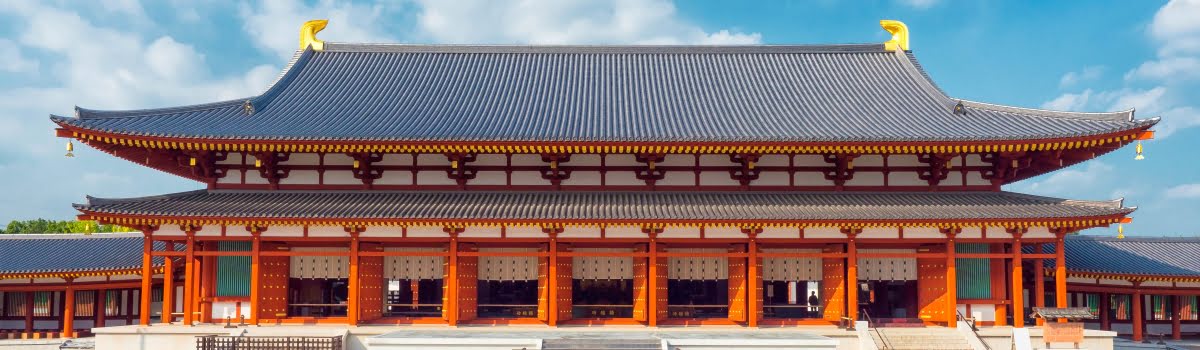
Yakushiji Temple is located just a few minutes’ walk south from Toshodaiji Temple, back towards Nishinokyo Station. Another one of Japan’s oldest temples, it was constructed in the late 7th century by the Emperor Tenmu to pray for the health of his sick wife. Just like Shinyakushiji Temple, it is dedicated to the Buddha of healing. The Yakushiji Temple complex is large and sprawling, with numerous buildings to explore. However, the only original building that still stands today is the temple’s East Pagoda, which was constructed in the 8th century. It is widely regarded as one of the finest pagodas in all of Japan. The main hall was rebuilt in the 1970s and the West Pagoda in the 1980s. Yakushiji Temple serves as the headquarters of the Hosso school of Buddhism.
Genjo-sanzoin Garan
While Yakushiji Temple is largely known for its historical importance, just north of the main temple complex you will also find the more recently constructed area known as Genjo-sanzoin Garan. Built in 1991, this precinct is dedicated to Genjo-sanzo, a 7th-century Chinese monk who was renowned for his travels around Asia and whose teachings had a major influence on Hosso Buddhism. The most prominent building at Genjo-sanzoin Garan is the octagonal central hall which sits in the center of the beautiful stone-flagged courtyard and which enshrines some of Genjo-sanzo’s remains. Behind the hall is a building displaying the works of celebrated Japanese painter Hirayama Ikuo, who was inspired by the journeys of Genjo-sanzo.
As Yakushiji Temple is only a hop away from Nishinokyo Station, you’ll have an easy time getting back to Osaka or Kyoto in 40 minutes, or transferring onto a train to any other destination in Japan.
** The photographs contained on this article are protected by copyright law. Any secondary usage of photos in this article without prior consent is prohibited.
We, together with our partners, use cookies and similar technologies to collect data about you to understand how visitors interact with our platform, improve our services, and provide you with tailored content and ads. These ads may appear on this site, other websites, apps, or social media platforms based on your interactions with us and other platforms. Additionally, cookies allow you to interact with social media sites. You can change your preferences at any time. To learn more about how we and our partners use and share your information, and to manage your preferences, please review Agoda Privacy and Cookies Policy and Terms of Use.